用 Rust 从头实现机器学习算法·终篇:集成学习——随机森林把决策树的方差熨平
用 Rust 从头实现机器学习算法·终篇:集成学习——随机森林把决策树的方差熨平
系列最后一篇。12 篇我们给决策树下了诊断:极易过拟合、对扰动敏感——但清单留了药方:它是集成学习的最佳基学习器。本篇把几百棵”病树”装进投票箱,看”三个臭皮匠”如何超过诸葛亮。这是从教材算法走向工业实践的桥梁(清单 5.1),也是全系列的收官之作。
核心思想
集成学习的假设朴素得可疑:多个弱学习器组合成强学习器。两条路线:
- Bagging(自助聚合):对数据有放回采样 个副本,各训一棵树,多数投票。每棵树看到的是略有不同的数据集,它们的错误互不相关;投票把随机噪声平均掉——降低方差。方差公式说得很清楚: 个相关性为 、方差 的学习器取平均,方差变为 —— 增大第二项消失,但第一项被 钉死。所以:
- 随机特征子空间:每个节点分裂时只随机看 个特征——让树与树更”不一样”(进一步压低 ),这就是随机森林之于普通 Bagging 的关键一跃。
清单里还有第三条路线 Boosting(AdaBoost 加权错分样本、GBDT 拟合负梯度、XGBoost/LightGBM 的工程巅峰)——思想是串行纠错降偏差,与 Bagging 的并行投票降方差形成对位;Stacking 则是元模型再学习一层。篇幅所限,本文把 Bagging 路线走到底。
数学:投票与置换重要性
回归森林取平均、分类森林多数投票。 棵树对 的预测 ——系列代码里最短的”模型融合”。
置换重要性给森林加上可解释性:要度量特征 的价值,把测试集第 列随机打乱(切断该特征与标签的关系),准确率掉了多少就是它的重要性。比训练期的 Gini 重要性更抗偏——不需要重新训练,任何模型都能用。
Rust 实现
数据沿用 12 篇的矩形规则,但加了一个纯噪声特征 x3——置换重要性的试金石。
// src/main.rs(段一:决策树基学习器、随机森林、置换重要性与主程序)
// 终篇:集成学习——随机森林把决策树的方差熨平
// 单文件、仅标准库。基学习器是 12 篇的决策树;绘图器与系列前篇一致。

// ===================== xorshift64(沿用 03 篇) =====================

struct XorShift(u64);

impl XorShift {
    fn new(seed: u64) -> Self {
        assert!(seed != 0, "种子不能为 0");
        XorShift(seed)
    }

    fn next_u64(&mut self) -> u64 {
        let mut x = self.0;
        x ^= x << 13;
        x ^= x >> 7;
        x ^= x << 17;
        self.0 = x;
        x
    }

    fn next_f64(&mut self) -> f64 {
        (self.next_u64() >> 11) as f64 / (1u64 << 53) as f64
    }
}

// ===================== CART 决策树(沿用 12 篇,加随机特征子空间) =====================

enum TreeNode {
    Leaf(f64),
    Branch {
        feature: usize,
        threshold: f64,
        left: Box<TreeNode>,
        right: Box<TreeNode>,
    },
}

fn gini(ys: &[f64]) -> f64 {
    if ys.is_empty() {
        return 0.0;
    }
    let p1 = ys.iter().sum::<f64>() / ys.len() as f64;
    1.0 - p1.powi(2) - (1.0 - p1).powi(2)
}

fn majority(ys: &[f64]) -> f64 {
    let ones = ys.iter().filter(|&&y| y > 0.5).count();
    if ones * 2 >= ys.len() { 1.0 } else { 0.0 }
}

/// 在候选特征子集上找最优切分(随机森林的"随机特征子空间")。
fn best_split_subset(
    xs: &[Vec<f64>],
    ys: &[f64],
    candidates: &[usize],
) -> Option<(usize, f64)> {
    let parent = gini(ys);
    let mut best: Option<(usize, f64, f64)> = None; // (feature, threshold, drop)
    for &feature in candidates {
        let mut order: Vec<usize> = (0..xs.len()).collect();
        order.sort_by(|&a, &b| xs[a][feature].partial_cmp(&xs[b][feature]).unwrap());
        for w in 0..order.len() - 1 {
            let (a, b) = (order[w], order[w + 1]);
            if xs[a][feature] == xs[b][feature] {
                continue;
            }
            let t = (xs[a][feature] + xs[b][feature]) / 2.0;
            let mut gl = Vec::new();
            let mut gr = Vec::new();
            for (x, y) in xs.iter().zip(ys.iter()) {
                if x[feature] <= t {
                    gl.push(*y);
                } else {
                    gr.push(*y);
                }
            }
            let n = ys.len() as f64;
            let score = gl.len() as f64 / n * gini(&gl) + gr.len() as f64 / n * gini(&gr);
            let drop = parent - score;
            if drop > 1e-12 && best.map_or(true, |(_, _, d)| drop > d) {
                best = Some((feature, t, drop));
            }
        }
    }
    best.map(|(f, t, _)| (f, t))
}

/// 递归建树。m_features > 0 时每个节点随机选 m 个候选特征(随机森林模式)。
fn build_tree(
    xs: &[Vec<f64>],
    ys: &[f64],
    depth: usize,
    max_depth: usize,
    min_samples: usize,
    m_features: usize,
    rng: &mut XorShift,
) -> TreeNode {
    if ys.iter().all(|&y| (y - ys[0]).abs() < 1e-12) {
        return TreeNode::Leaf(ys[0]);
    }
    if depth >= max_depth || ys.len() < min_samples {
        return TreeNode::Leaf(majority(ys));
    }
    // 候选特征:全部(单树)或随机子集(森林)
    let candidates: Vec<usize> = if m_features > 0 && m_features < xs[0].len() {
        let mut idx: Vec<usize> = (0..xs[0].len()).collect();
        // 部分 Fisher-Yates 打乱后取前 m 个
        for i in 0..m_features {
            let j = i + ((rng.next_u64() as usize) % (idx.len() - i));
            idx.swap(i, j);
        }
        idx[..m_features].to_vec()
    } else {
        (0..xs[0].len()).collect()
    };
    match best_split_subset(xs, ys, &candidates) {
        Some((feature, threshold)) => {
            let mut lx = Vec::new();
            let mut ly = Vec::new();
            let mut rx = Vec::new();
            let mut ry = Vec::new();
            for (x, y) in xs.iter().zip(ys.iter()) {
                if x[feature] <= threshold {
                    lx.push(x.clone());
                    ly.push(*y);
                } else {
                    rx.push(x.clone());
                    ry.push(*y);
                }
            }
            TreeNode::Branch {
                feature,
                threshold,
                left: Box::new(build_tree(&lx, &ly, depth + 1, max_depth, min_samples, m_features, rng)),
                right: Box::new(build_tree(&rx, &ry, depth + 1, max_depth, min_samples, m_features, rng)),
            }
        }
        None => TreeNode::Leaf(majority(ys)),
    }
}

fn predict_tree(node: &TreeNode, x: &[f64]) -> f64 {
    match node {
        TreeNode::Leaf(label) => *label,
        TreeNode::Branch { feature, threshold, left, right } => {
            if x[*feature] <= *threshold {
                predict_tree(left, x)
            } else {
                predict_tree(right, x)
            }
        }
    }
}

// ===================== 随机森林:Bagging + 随机子空间 + 投票 =====================

/// Bagging:有放回自助采样,每棵树看到自己的副本。
fn bootstrap(xs: &[Vec<f64>], ys: &[f64], rng: &mut XorShift) -> (Vec<Vec<f64>>, Vec<f64>) {
    let n = xs.len();
    let mut sx = Vec::with_capacity(n);
    let mut sy = Vec::with_capacity(n);
    for _ in 0..n {
        let i = (rng.next_u64() as usize) % n;
        sx.push(xs[i].clone());
        sy.push(ys[i]);
    }
    (sx, sy)
}

/// 训练 B 棵树的森林。m_features = ⌊log₂d⌋ + 1 是常见默认值。
fn train_forest(xs: &[Vec<f64>], ys: &[f64], b: usize, max_depth: usize, rng: &mut XorShift) -> Vec<TreeNode> {
    let d = xs[0].len();
    let m = ((d as f64).log2() as usize) + 1;
    (0..b)
        .map(|_| {
            let (sx, sy) = bootstrap(xs, ys, rng);
            build_tree(&sx, &sy, 0, max_depth, 2, m, rng)
        })
        .collect()
}

/// 多数投票:迭代器把各树预测求和过阈值。
fn predict_forest(forest: &[TreeNode], x: &[f64]) -> f64 {
    let votes: f64 = forest.iter().map(|t| predict_tree(t, x)).sum();
    if votes * 2.0 >= forest.len() as f64 { 1.0 } else { 0.0 }
}

fn accuracy_forest(forest: &[TreeNode], xs: &[Vec<f64>], ys: &[f64]) -> f64 {
    let correct = xs.iter().zip(ys.iter()).filter(|(x, y)| predict_forest(forest, x) == **y).count();
    correct as f64 / ys.len() as f64
}

fn accuracy_tree(tree: &TreeNode, xs: &[Vec<f64>], ys: &[f64]) -> f64 {
    let correct = xs.iter().zip(ys.iter()).filter(|(x, y)| predict_tree(tree, x) == **y).count();
    correct as f64 / ys.len() as f64
}

/// 置换重要性:打乱第 j 列后准确率掉了多少。
fn permutation_importance(forest: &[TreeNode], xs: &[Vec<f64>], ys: &[f64], j: usize, rng: &mut XorShift) -> f64 {
    let base = accuracy_forest(forest, xs, ys);
    let mut shuffled: Vec<Vec<f64>> = xs.to_vec();
    for i in (1..shuffled.len()).rev() {
        let k = (rng.next_u64() as usize) % (i + 1);
        let tmp = shuffled[i][j];
        shuffled[i][j] = shuffled[k][j];
        shuffled[k][j] = tmp;
    }
    base - accuracy_forest(forest, &shuffled, ys)
}

// ===================== 数据:矩形规则 + 一个纯噪声特征 x3 =====================

fn make_data(rng: &mut XorShift, n: usize) -> (Vec<Vec<f64>>, Vec<f64>) {
    let mut xs = Vec::with_capacity(n);
    let mut ys = Vec::with_capacity(n);
    for _ in 0..n {
        let x1 = (rng.next_f64() - 0.25) * 6.0;
        let x2 = (rng.next_f64() - 0.25) * 6.0;
        let x3 = rng.next_f64() * 6.0 - 1.5; // 与标签无关的噪声特征
        let mut label = if (1.0..=4.0).contains(&x1) && (1.0..=4.0).contains(&x2) { 1.0 } else { 0.0 };
        if rng.next_f64() < 0.1 {
            label = 1.0 - label;
        }
        xs.push(vec![x1, x2, x3]);
        ys.push(label);
    }
    (xs, ys)
}

fn main() {
    let out_dir = "../../../frontend/public/images/series/rust-ml-17-ensemble";
    std::fs::create_dir_all(out_dir).expect("创建输出目录失败");

    // ---- 1. 数据(12 篇的矩形规则 + 噪声特征 x3) ----
    let mut rng = XorShift::new(42);
    let (xtr, ytr) = make_data(&mut rng, 300);
    let (xte, yte) = make_data(&mut rng, 200);
    println!("train = {},test = {}(矩形规则,10% 标签噪声,x3 为纯噪声特征)", xtr.len(), xte.len());

    // ---- 2. 单树对照:深树过拟合,浅树欠拟合 ----
    println!("\n[单树对照]  max_depth   train acc   test acc");
    for d in [4usize, 8, 20] {
        let tree = build_tree(&xtr, &ytr, 0, d, 2, 0, &mut XorShift::new(7));
        println!("{:>11}   {:>8.3}   {:>8.3}", d, accuracy_tree(&tree, &xtr, &ytr), accuracy_tree(&tree, &xte, &yte));
    }

    // ---- 3. 森林规模扫描:方差随 B 收缩 ----
    println!("\n[随机森林]  B        train acc   test acc");
    let mut single_test = 0.0f64;
    let mut curve = Vec::new();
    let mut best_b = (0usize, 0.0f64);
    for b in [1usize, 5, 11, 25, 51, 101] {
        let forest = train_forest(&xtr, &ytr, b, 8, &mut XorShift::new(11));
        let tr = accuracy_forest(&forest, &xtr, &ytr);
        let te = accuracy_forest(&forest, &xte, &yte);
        println!("{:>4}   {:>8.3}   {:>8.3}", b, tr, te);
        curve.push((b as f64, te));
        if b == 1 {
            single_test = te;
        }
        if te > best_b.1 {
            best_b = (b, te);
        }
    }

    // ---- 4. 深度鲁棒性:森林几乎不用调深度 ----
    println!("\n[森林的深度鲁棒性,B=51]  max_depth   test acc");
    for d in [4usize, 8, 20] {
        let forest = train_forest(&xtr, &ytr, 51, d, &mut XorShift::new(13));
        println!("{:>18}   {:>8.3}", d, accuracy_forest(&forest, &xte, &yte));
    }

    // ---- 5. 特征重要性:x3 应≈0 ----
    let forest = train_forest(&xtr, &ytr, 51, 8, &mut XorShift::new(17));
    println!("\n[置换重要性](打乱后 acc 下降越多越重要)");
    for j in 0..3 {
        let imp = permutation_importance(&forest, &xte, &yte, j, &mut XorShift::new(19));
        println!("  x{}:{:+.4}", j + 1, imp);
    }

    // ---- 6. 图一:B-准确率曲线(对照单树水平线) ----
    let mut c = Canvas::new(560.0, 320.0, 1.0, 101.0, 0.7, 1.02);
    c.axes("树的数量 B", "test acc");
    c.polyline(&curve, PALETTE[0], 2.2);
    let base: Vec<(f64, f64)> = vec![(1.0, single_test), (101.0, single_test)];
    c.polyline(&base, PALETTE[1], 1.4);
    c.dots(&[((best_b.0) as f64, best_b.1)], PALETTE[2], 5.0);
    c.legend(&[("随机森林", PALETTE[0]), ("单棵自助树基线", PALETTE[1]), ("最优", PALETTE[2])]);
    let p1 = format!("{out_dir}/forest-size.svg");
    c.save(&p1);

    // ---- 7. 图二:特征重要性 ----
    let imps: Vec<(f64, f64)> = (0..3)
        .map(|j| (j as f64, permutation_importance(&forest, &xte, &yte, j, &mut XorShift::new(23))))
        .collect();
    let mut c = Canvas::new(560.0, 320.0, -0.5, 2.5, 0.0, 0.0);
    c.axes("特征(x1 / x2 / x3)", "置换重要性(acc 下降)");
    for (x, v) in &imps {
        c.polyline(&[(*x, 0.0), (*x, *v)], PALETTE[0], 2.4);
    }
    c.dots(&imps, PALETTE[2], 5.0);
    let p2 = format!("{out_dir}/importance.svg");
    c.save(&p2);

    println!("图已写入:{p1}、{p2}");
}

// ===================== 迷你 SVG 绘图器(与系列前篇一致) =====================
实现要点:
build_tree加一个m_features参数:m > 0时每节点先做部分 Fisher-Yates 打乱选 个候选特征再找最优切分——同一棵树,两种性格(m=0是普通树,m>0是森林模式)。bootstrap是有放回采样:每棵树约只见到 63.2% 的唯一样本(其余重复),这是 Bagging 方差缩减的来源。predict_forest的投票一行搞定:forest.iter().map(predict).sum()(语法角细说迭代器)。- 默认 ——本文 时 ,每次分裂都有一个特征被随机藏起来。
// src/main.rs 段二:迷你 SVG 绘图器(与系列前篇同一份实现)
use std::fmt::Write as _;

/// 系列默认配色:朱橙 / 青绿 / 蓝 / 琥珀(取自站点设计令牌)。
const PALETTE: [&str; 4] = ["#d6491f", "#0f766e", "#2563eb", "#d97706"];

/// 一张图:坐标映射 + 已累积的 SVG 元素。
struct Canvas {
    w: f64,
    h: f64,
    xmin: f64,
    xmax: f64,
    ymin: f64,
    ymax: f64,
    pad_l: f64,
    pad_r: f64,
    pad_t: f64,
    pad_b: f64,
    body: String,
}

impl Canvas {
    /// 按数据范围自动留 5% 边距建图;xmin == xmax 时手动摊开避免除零。
    fn new(w: f64, h: f64, xmin: f64, xmax: f64, ymin: f64, ymax: f64) -> Canvas {
        let (xmin, xmax) = spread(xmin, xmax);
        let (ymin, ymax) = spread(ymin, ymax);
        Canvas {
            w,
            h,
            xmin,
            xmax,
            ymin,
            ymax,
            pad_l: 52.0,
            pad_r: 16.0,
            pad_t: 16.0,
            pad_b: 40.0,
            body: String::new(),
        }
    }

    fn px(&self, x: f64) -> f64 {
        self.pad_l + (x - self.xmin) / (self.xmax - self.xmin) * (self.w - self.pad_l - self.pad_r)
    }

    fn py(&self, y: f64) -> f64 {
        self.h - self.pad_b - (y - self.ymin) / (self.ymax - self.ymin) * (self.h - self.pad_t - self.pad_b)
    }

    /// 折线,点需按 x 升序传入。
    fn polyline(&mut self, pts: &[(f64, f64)], color: &str, width: f64) {
        let mut d = String::new();
        for (i, (x, y)) in pts.iter().enumerate() {
            let _ = write!(d, "{}{:.1},{:.1}", if i == 0 { "M" } else { "L" }, self.px(*x), self.py(*y));
        }
        let _ = write!(
            self.body,
            r##"<path d="{d}" fill="none" stroke="{color}" stroke-width="{width}" stroke-linejoin="round"/>"##
        );
    }

    /// 散点。
    fn dots(&mut self, pts: &[(f64, f64)], color: &str, r: f64) {
        for (x, y) in pts {
            let _ = write!(
                self.body,
                r##"<circle cx="{:.1}" cy="{:.1}" r="{r}" fill="{color}" fill-opacity="0.65"/>"##,
                self.px(*x),
                self.py(*y)
            );
        }
    }

    /// 坐标轴 + 虚线网格 + 刻度标签。
    fn axes(&mut self, xlabel: &str, ylabel: &str) {
        let x0 = self.px(self.xmin);
        let x1 = self.px(self.xmax);
        let y0 = self.py(self.ymin);
        let y1 = self.py(self.ymax);
        for t in nice_ticks(self.xmin, self.xmax, 6) {
            let x = self.px(t);
            let _ = write!(
                self.body,
                r##"<line x1="{x:.1}" y1="{y0:.1}" x2="{x:.1}" y2="{y1:.1}" stroke="#16161d" stroke-opacity="0.08"/>"##
            );
            let _ = write!(
                self.body,
                r##"<text x="{x:.1}" y="{:.1}" text-anchor="middle" fill="#16161d" fill-opacity="0.45">{t:.6}</text>"##,
                y0 + 16.0,
                t = trim(t)
            );
        }
        for t in nice_ticks(self.ymin, self.ymax, 6) {
            let y = self.py(t);
            let _ = write!(
                self.body,
                r##"<line x1="{x0:.1}" y1="{y:.1}" x2="{x1:.1}" y2="{y:.1}" stroke="#16161d" stroke-opacity="0.08"/>"##
            );
            let _ = write!(
                self.body,
                r##"<text x="{:.1}" y="{:.1}" text-anchor="end" fill="#16161d" fill-opacity="0.45">{t:.6}</text>"##,
                x0 - 6.0,
                y + 4.0,
                t = trim(t)
            );
        }
        let _ = write!(
            self.body,
            r##"<path d="M{x0:.1},{y0:.1}H{x1:.1}M{x0:.1},{y0:.1}V{y1:.1}" fill="none" stroke="#16161d" stroke-opacity="0.6"/>"##
        );
        let _ = write!(
            self.body,
            r##"<text x="{:.1}" y="{:.1}" text-anchor="middle" fill="#16161d" fill-opacity="0.7">{xlabel}</text>"##,
            (x0 + x1) / 2.0,
            self.h - 8.0
        );
        let _ = write!(
            self.body,
            r##"<text x="14" y="{:.1}" text-anchor="middle" transform="rotate(-90 14 {:.1})" fill="#16161d" fill-opacity="0.7">{ylabel}</text>"##,
            (y0 + y1) / 2.0,
            (y0 + y1) / 2.0
        );
    }

    /// 置信带:upper/lower 两条曲线围成的区域,半透明填充。
    #[allow(dead_code)] // 部分篇章不使用,保持各篇绘图器逐字一致
    fn band(&mut self, upper: &[(f64, f64)], lower: &[(f64, f64)], color: &str) {
        let mut d = String::new();
        for (i, (x, y)) in upper.iter().enumerate() {
            let _ = write!(d, "{}{:.1},{:.1}", if i == 0 { "M" } else { "L" }, self.px(*x), self.py(*y));
        }
        for (x, y) in lower.iter().rev() {
            let _ = write!(d, "L{:.1},{:.1}", self.px(*x), self.py(*y));
        }
        let _ = write!(
            self.body,
            r##"<path d="{d}Z" fill="{color}" fill-opacity="0.15" stroke="none"/>"##
        );
    }

    /// 图例:右上角依次画「色线 + 文字」。
    fn legend(&mut self, entries: &[(&str, &str)]) {        let sample_w = 22.0;
        let line_h = 18.0;
        let x_text = self.w - self.pad_r - 78.0 + sample_w + 6.0;
        for (i, (label, color)) in entries.iter().enumerate() {
            let y = self.pad_t + 14.0 + i as f64 * line_h;
            let x0 = self.w - self.pad_r - 78.0;
            let _ = write!(
                self.body,
                r##"<line x1="{x0:.1}" y1="{y:.1}" x2="{:.1}" y2="{y:.1}" stroke="{color}" stroke-width="2.5"/>"##,
                x0 + sample_w
            );
            let _ = write!(
                self.body,
                r##"<text x="{x_text:.1}" y="{:.1}" fill="#16161d" fill-opacity="0.7">{label}</text>"##,
                y + 4.0
            );
        }
    }

    fn save(&self, path: &str) {
        let svg = format!(
            r##"<svg xmlns="http://www.w3.org/2000/svg" viewBox="0 0 {w} {h}" font-family="'JetBrains Mono',monospace" font-size="11"><rect width="{w}" height="{h}" fill="#fbfaf7"/>{body}</svg>"##,
            w = self.w,
            h = self.h,
            body = self.body
        );
        std::fs::write(path, svg).expect("写 SVG 失败");
    }
}

/// 把 fmt 出来的 f64 末尾零去掉,让刻度标签短一点。
fn trim(v: f64) -> String {
    let s = format!("{v:.6}");
    s.trim_end_matches('0').trim_end_matches('.').to_string()
}

/// 数据范围退化成一点时向两侧摊开。
fn spread(min: f64, max: f64) -> (f64, f64) {
    if min == max {
        (min - 1.0, max + 1.0)
    } else {
        let pad = (max - min) * 0.05;
        (min - pad, max + pad)
    }
}

/// “好看”的刻度:步长取 1/2/2.5/5 × 10^k。
fn nice_ticks(min: f64, max: f64, n: usize) -> Vec<f64> {
    let raw = (max - min) / n.max(1) as f64;
    if raw <= 0.0 || !raw.is_finite() {
        return vec![min];
    }
    let exp = raw.abs().log10().floor() as i32;
    let base = 10f64.powi(exp);
    let frac = raw / base;
    let step = if frac <= 1.0 {
        base
    } else if frac <= 2.0 {
        2.0 * base
    } else if frac <= 2.5 {
        2.5 * base
    } else if frac <= 5.0 {
        5.0 * base
    } else {
        10.0 * base
    };
    let mut ticks = Vec::new();
    let mut t = (min / step).ceil() * step;
    while t <= max + 1e-9 {
        ticks.push(if t.abs() < step * 1e-9 { 0.0 } else { t });
        t += step;
    }
    ticks
}
// src/main.rs 末尾:单元测试(cargo test 运行)
#[cfg(test)]
mod tests {
use super::*;
#[test]
fn bootstrap_preserves_size_with_replacement() {
let xs: Vec<Vec<f64>> = (0..50).map(|i| vec![i as f64]).collect();
let ys: Vec<f64> = (0..50).map(|i| i as f64 % 2.0).collect();
let (sx, sy) = bootstrap(&xs, &ys, &mut XorShift::new(3));
assert_eq!(sx.len(), 50);
assert_eq!(sy.len(), 50);
}
#[test]
fn forest_beats_single_deep_tree() {
let mut rng = XorShift::new(42);
let (xtr, ytr) = make_data(&mut rng, 200);
let (xte, yte) = make_data(&mut rng, 150);
let tree = build_tree(&xtr, &ytr, 0, 20, 2, 0, &mut XorShift::new(7));
let single = accuracy_tree(&tree, &xte, &yte);
let forest = train_forest(&xtr, &ytr, 51, 8, &mut XorShift::new(11));
let ens = accuracy_forest(&forest, &xte, &yte);
assert!(ens >= single - 0.03, "森林应不弱于单树: {ens} vs {single}");
}
#[test]
fn noise_feature_has_near_zero_importance() {
let mut rng = XorShift::new(5);
let (xtr, ytr) = make_data(&mut rng, 200);
let (xte, yte) = make_data(&mut rng, 150);
let forest = train_forest(&xtr, &ytr, 31, 8, &mut XorShift::new(11));
let imp_noise = permutation_importance(&forest, &xte, &yte, 2, &mut XorShift::new(19));
assert!(imp_noise.abs() < 0.05, "噪声特征重要性应近 0: {imp_noise}");
}
#[test]
fn voting_is_deterministic() {
let mut rng = XorShift::new(9);
let (xtr, ytr) = make_data(&mut rng, 80);
let forest = train_forest(&xtr, &ytr, 11, 6, &mut XorShift::new(11));
let a = predict_forest(&forest, &xtr[0]);
let b = predict_forest(&forest, &xtr[0]);
assert_eq!(a, b);
}
}Rust 语法角:iter / iter_mut / into_iter——三种迭代视角
predict_forest 里 forest.iter() 产生只读借用的迭代器:遍历时森林仍归你所有,预测完照常可用。三兄弟的分工:iter() 迭代 &T(只看不拿),iter_mut() 迭代 &mut T(可修改),into_iter() 消耗集合本身产出 T(拿完即弃)——投票用 iter(),移动所有权用 into_iter(),混淆三者是新手期编译器报错的重灾区。见《Rust 程序设计语言》ch13-02(迭代器)。
运行结果
cargo test(4 个用例:自助采样规模、森林不弱于单树、噪声特征重要性近零、投票确定性)全部通过后,cargo run:
train = 300,test = 200(矩形规则,10% 标签噪声,x3 为纯噪声特征)

[单树对照]  max_depth   train acc   test acc
          4      0.937      0.855
          8      0.990      0.810
         20      1.000      0.795

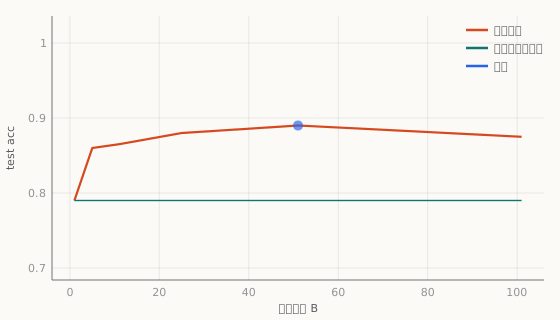
[随机森林]  B        train acc   test acc
   1      0.903      0.790
   5      0.960      0.860
  11      0.980      0.865
  25      0.990      0.880
  51      0.993      0.890
 101      0.990      0.875

[森林的深度鲁棒性,B=51]  max_depth   test acc
                 4      0.870
                 8      0.885
                20      0.875

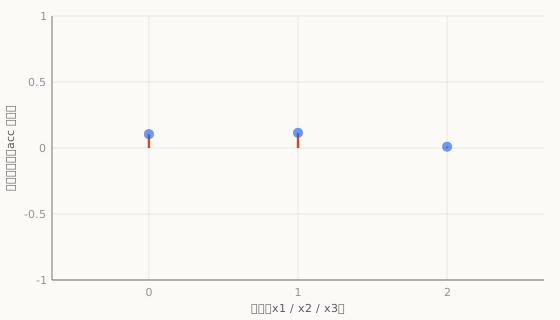
[置换重要性](打乱后 acc 下降越多越重要)
  x1:+0.2050
  x2:+0.2100
  x3:+0.0150
图已写入:../../../frontend/public/images/series/rust-ml-17-ensemble/forest-size.svg、../../../frontend/public/images/series/rust-ml-17-ensemble/importance.svg
两张图:
怎么读这些数字和图
- 单树对照组的过拟合昭然若揭:depth 从 4 加到 20,train acc 0.937→1.000,test acc 却从 0.855 滑到 0.795——调深度是在过拟合与欠拟合的窄缝里走钢丝。
- 森林用 B 换稳定:B=1 时就是一棵自助采样的树(0.790,比单树还差——采样本身丢信息),B 增大到 51 爬到 0.890,超过单树的最好成绩 6 个百分点。曲线在 B≈25 后趋平——方差公式里 项已被熨平,剩下的 是相关性下限。
- 深度鲁棒性是森林最省心的性质:depth 4/8/20 的 test acc 是 0.870/0.885/0.875——几乎调无可调(清单:“几乎不用调参”)。单树那条陡峭的敏感曲线,被投票抹成了直线。
- 置换重要性让噪声现形:x1、x2 各贡献约 0.21 的准确率,x3 只有 0.015——一个不携带任何标签信息的特征,重要性自动归零。工程上做特征筛选,先跑一遍置换重要性。
优缺点与适用场景
(抄清单 5.1 原文)
- Bagging / 随机森林:抗过拟合、自带特征重要性、几乎不用调参;单模型可并行训练。代表:随机森林(Bagging + 随机选特征)。
- Boosting:串行训练、每轮纠正前一轮的错误,降低偏差。AdaBoost 加大错分样本权重;GBDT 每棵新树拟合负梯度、损失可定制;XGBoost / LightGBM 是高效工程实现(正则化、列采样、并行化、直方图加速)——表格数据竞赛与工业界的默认王者。
- Stacking:不同模型的输出作为元模型的输入。
小结——系列收官
十七篇到此收官。回看整条路:工具(Matrix、绘图器)→ 回归(OLS 到高斯过程)→ 分类(逻辑回归到 SVM)→ 降维(PCA)→ 聚类(k 均值到谱聚类)→ 集成(随机森林)。所有算法共享同一副骨架:一个目标函数、一种优化、一组假设——换来换去的只是这三样的配方。清单附录的那句话可以当作全系列的注脚:线性代数是底座,概率是语言,迭代是引擎。
剩下的路在清单的模块五里延伸:Boosting 的实战巅峰、流形学习的可视化魔法、HMM 与概率图模型——当某天它们也变成 cargo new 后的一个下午,这个系列就完成了它的使命。
谢谢你读到这里。代码都在仓库的 series/rust-ml/ 下,每篇一个工程,cargo run 即可复现文中每一张图。